
Frontier AI Changed the Threat Model
AI is accelerating the creation and discovery of cyber risk. See how frontier cyber AI helps security teams continuously discover, validate, prioritize, and remediate the exposures that matter.

The exposure gap is widening
AI is accelerating how quickly organizations build and change applications, infrastructure, and AI systems. It is also accelerating vulnerability discovery and shrinking the window to respond.
H1 Platform data shows the growing pressure: unresolved critical issues increased 29x over the last year, even as mean time to remediate critical findings improved by more than 50%. AI-related vulnerabilities reported on the H1 Platform rose more than 200% in 2025, while prompt injection reports jumped 540%.
As frontier cyber AI becomes more capable and accessible, organizations must continuously discover, validate, prioritize, and remediate exposures before they become harder to manage.



What HackerOne Learned Running a Frontier Model on Our Own Codebase
Frontier cyber AI can surface complex vulnerabilities that conventional approaches may struggle to detect. HackerOne security leaders share what 30 days of internal testing with Mythos revealed about the changing speed and depth of vulnerability discovery, and what it means for defenders.

The Expanding AI Attack Surface: Closing Risk Gaps Through Continuous Security
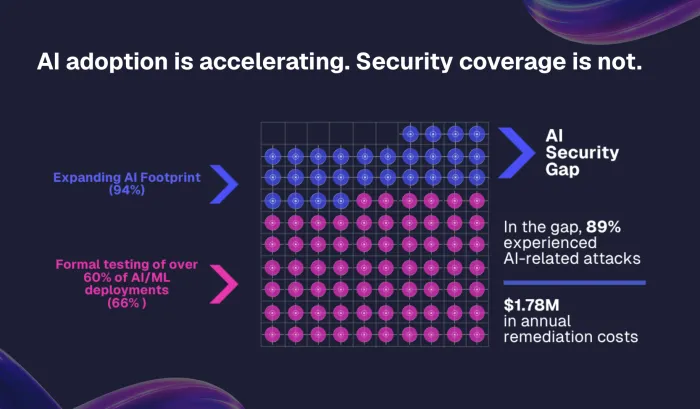
94% of security leaders expanded their AI footprint in the past year. Only 66% formally test most of those systems. This research quantifies the coverage gap, maps where AI-related attacks are already landing, and identifies the testing methods that separate prepared organizations from vulnerable ones.

Rent, Wrap, or Own: Rethinking Build vs. Buy in AI Security
AI has made security capabilities easier to build, but making them dependable is a different challenge. This guide breaks down the real costs behind building and maintaining AI security workflows, from evaluation and observability to governance and model orchestration, and offers a framework for deciding what to build, buy, or manage yourself.

Some CISOs Feel Prepared for AI, Some Don't: Here's the Difference
The gap between prepared and unprepared AI security programs is defined by the breadth of testing methods. This breakdown covers what each of the seven methods catches, why no single tool covers the full AI attack surface, and how to stitch them into a continuous program that keeps pace with AI in production.
Secure Your AI Before It Scales: Real-World LLM Exploits and How to Stop Them
Prompt injection, tool misuse, and data exfiltration through agent pipelines are becoming the new norm. This session walks through real LLM exploits observed in production environments and the practical controls security teams can put in place before AI systems scale beyond their ability to monitor them.
The New Metrics That Matter: How to Brief Your Board on AI-Accelerated Exposure
Vulnerability submissions are up, resolutions are falling, and the backlog is growing faster than most teams can report on it. This guide defines the three metrics that reflect the current threat reality and shows how to frame them for executive and board audiences.

Put Frontier Cyber AI to Work for Defense.
HackerOne is integrating frontier cyber AI models from Anthropic and OpenAI into select H1 Platform products. This brings the latest advances in cyber AI into the security workflows organizations already use to discover, validate, prioritize, and remediate exposures.
Access to a frontier model is only the starting point. The H1 Platform integrates these capabilities through an operational harness designed to apply controls, improve coverage, validate model outputs, support deep root cause analysis, and connect validated findings to remediation.
Frontier Cyber AI
Frontier cyber AI refers to a class of cybersecurity AI models in which safeguards that normally restrict offensive security capabilities have been removed, such as OpenAI's Daybreak and Anthropic's Mythos.
H1 Platform Harness
The H1 Platform's harness sits between the frontier cyber AI model and the security team as an operational layer: it scopes what the model can touch, validates what it finds against noise, and traces every confirmed finding to a fix a developer can act on.
H1 Code Security Audit
Repository scans on frontier cyber AI for deeper code reasoning to see what current tooling misses.
H1 Remediation
Frontier cyber AI findings arrive with source code-informed root cause analysis and a developer-ready fix plan, delivered into Jira, Linear, or ServiceNow in one click.
H1 Code
Pull request reviews on frontier cyber AI for higher-signal findings at the point of change before issues compound.
Frequently Asked Questions about AI Cybersecurity and Frontier AI
Most security tools were built to find known vulnerability patterns at scale. Frontier cyber AI reasons across code the way an attacker does, identifying compositional risks that span years of commits and multiple authors, not just individual functions or known CVEs. The difference is in the class of vulnerability each approach is built to catch, and why AI cybersecurity programs need to account for both.
AI-related vulnerabilities on the H1 Platform increased more than 200% in 2025, and prompt injection reports alone jumped 540%. Attackers are already using AI to find and chain exposures faster than traditional security programs can respond. The question isn't whether the threat is real. It's whether your security program is running the same class of models on the defensive side.
Periodic testing was designed for environments that change slowly. AI systems change at the speed of product iteration: prompts evolve, models get swapped, agent permissions expand, new tools get added. A test that ran three months ago doesn't reflect the attack surface you have today. The organizations pulling ahead are building continuous validation loops, not replacing periodic testing with a single better scan.
Finding more is only valuable if there's a path to fix. The unresolved critical vulnerability backlog grew 29x in 12 months on the H1 Platform, even as remediation times improved. More discovery without a connected fix path widens exposure debt. The organizations pulling ahead are building continuous validation loops, especially as agentic AI security demands testing that moves at the same pace as deployment.
HackerOne does not use or permit use of confidential researcher or customer vulnerability data to train or improve generative AI models. You can find more information in our Hai Security and Trust documentation and our Responsible AI at HackerOne blog.