CTEM vs. Vulnerability Management: Key Differences Explained

Last updated: September 2026
Continuous threat exposure management (CTEM) is a structured, iterative framework that helps organizations continuously discover, prioritize, validate, and remediate real, exploitable risk across their full attack surface, not just the vulnerabilities a scanner can find.
Vulnerability management has been a security staple for decades. Run a scan, get a list, prioritize by CVSS score, patch what you can, repeat next quarter.
But attackers don't work on a quarterly schedule. AI systems change weekly. Attack surfaces grow daily. And the CVE list never shrinks. Security teams are buried in scanner output while the risks that actually matter (exploitable, reachable, tied to business-critical systems) stay hidden in the noise.
When another organization suffers a breach, the first question a board asks is, “could that happen to us too?” Most vulnerability management programs can't answer that, but CTEM is built for it as a framework to identify and measure risk. Understanding why requires looking at what each approach actually does.
What Vulnerability Management Does
Vulnerability management (VM) is a repeatable process for identifying, classifying, and remediating known weaknesses. It relies on automated scanning to surface CVEs, misconfigurations, and missing patches, then prioritizes findings for remediation.
Done in isolation, vulnerability management has three structural limits.
- Scope. Traditional VM focuses on known assets: servers, endpoints, applications already in inventory. Shadow IT, third-party integrations, AI deployments, and cloud-native services often fall outside the scan perimeter entirely.
- Cadence. Most organizations scan weekly, monthly, or quarterly. Environments change faster. New code ships. Configurations drift. Threat actors find and exploit gaps between scan windows.
- Validation. A scanner confirms a vulnerability exists. It can't confirm whether it's exploitable in your environment, whether a compensating control already neutralizes it, or whether it sits on a path to something critical.
That validation gap is where real risk lives, and where vulnerability management, by itself, runs out of road.
What CTEM Does Differently
Continuous threat exposure management (CTEM), first introduced by Gartner, builds on vulnerability management while addressing its structural blind spots. It puts the scan inside a broader, continuous process designed to answer a harder question: of everything we know about, what actually poses exploitable risk to our business?
The CTEM cycle runs through five stages: scoping, discovery, prioritization, validation, and mobilization. Each builds on the last, and the cycle repeats continuously.
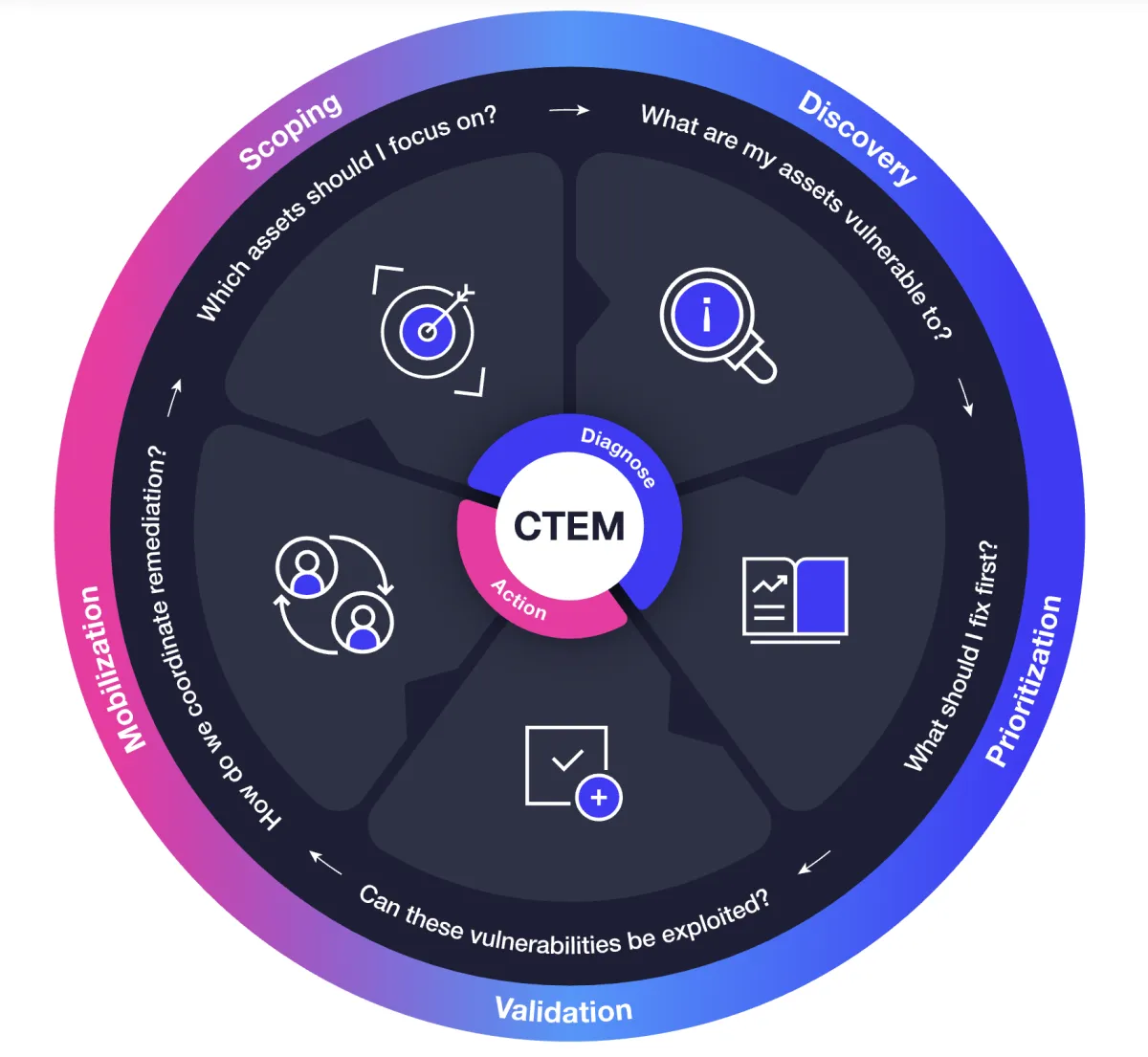
- Scoping starts with business context: systems, workflows, and data that matter. External attack surfaces, SaaS integrations, AI/ML deployments, and third-party APIs all come into scope.
- Discovery identifies the full range of assets and exposures within that scope, including findings that fall outside the CVE model: logic flaws, privilege escalation paths, insecure API behaviors, and AI-specific risks like prompt injection.
- Prioritization brings in an attacker perspective. CTEM ranks CVSS, but also factors in exploitability in your actual environment, reachability to critical assets, active threat actor behavior, and business impact.
- Validation is where CTEM most clearly parts ways with scanning. This stage confirms that exposures are actually exploitable, through adversarial testing, breach and attack simulation, or human-led red teaming. It also verifies that existing controls work as intended.
- Mobilization closes the loop by aligning remediation with business workflows, routing fixes to the right teams, and tracking outcomes.

Vulnerability Management vs. CTEM
Dimension | Vulnerability Management | CTEM |
Cadence | Periodic (weekly, monthly, quarterly) | Continuous: runs between, during, and after major changes |
Scope | Known assets, CVE-based findings | Full attack surface: managed assets, cloud, SaaS, AI/ML, third-party, shadow IT |
Prioritization | CVSS score, patch availability | Exploitability, reachability, business impact, active threat intel |
Validation | Scanner-confirmed existence | Adversarially confirmed exploitability in your environment |
Output | Vulnerability list with severity scores | Verified, exploitable risk ranked by business impact |
Remediation guidance | Patch recommendations | Prioritized remediation tied to actual risk reduction |
Executive reporting | Count of open/closed vulnerabilities | Validated risk, what was fixed, measurable business impact |
Human testing | Optional, periodic | Integral: embedded across discovery and validation |
AI/logic flaw coverage | Limited, scanner-dependent | Designed for it, adversarial and human-led testing |
The most important row is validation. Scanner-confirmed existence is not the same as adversarially confirmed exploitability. That gap, between "this vulnerability exists" and "this vulnerability can be exploited, here's the blast radius," is where most programs are operating blind.
Why CVSS-Based Prioritization Isn't Enough
CVSS scores measure the theoretical severity of a vulnerability in isolation. They don't measure whether it's exploitable in your environment, whether it's reachable from the internet, or whether it connects to anything an attacker would actually want.
That distinction matters. A CVSS 9.8 score on a vulnerability in an internal service behind multiple authentication layers carries very different risk than a CVSS 5.4 flaw in a customer-facing API that handles payment data. CVSS sees both. It can't tell you which one an attacker would go after first.
The problem compounds at scale. Enterprise environments routinely surface thousands of vulnerabilities per scan cycle. Prioritizing by severity score alone means high-CVSS findings that are already mitigated by compensating controls consume remediation capacity that should be going to lower-scored findings that are actively exploitable and sitting on a path to critical assets.
CTEM addresses this directly. Prioritization in a CTEM model layers exploitability, asset context, reachability, and active threat intelligence on top of severity scoring. A finding doesn't move to the front of the queue because it has a high CVSS score. It moves because it can be weaponized, it connects to something that matters, and there's evidence that attackers are targeting that class of vulnerability right now.
The practical outcome is a shorter, more defensible list of what to fix first based on proven risk.
Vulnerability Management Is a Component of CTEM, Not a Replacement
Vulnerability management finds a proper home in a CTEM model.
Automated scanning contributes to the discovery and continuous monitoring stages. It's fast, scalable, and effective at surfacing known CVEs across large inventories, providing the repeatable, high-volume layer of coverage no human team can match at scale.
CTEM adds the surrounding structure of scoping that ensures you're covering the right assets, prioritization that separates real risk from noise, adversarial validation that confirms exploitability, and mobilization that makes remediation reliable.
A mature CTEM program layers methods deliberately: automated scanning for breadth, human-led and AI-powered pentesting for depth, continuous bug bounty for ongoing discovery between audits, AI red teaming for AI-specific risk, and agentic offensive testing to stay ahead of an accelerating threat landscape.
What AI Does to the VM vs. CTEM Equation
AI changed what attackers can do, as well as the math that determines whether periodic, scanner-based security is viable at all.
On the attack surface side, enterprise AI adoption is expanding faster than security teams can track it. HackerOne research shows that 94% of organizations expanded their AI/ML footprint in the past year, but only 66% formally test more than 60% of their AI/ML systems.1 That 28-point gap represents a large and growing portion of the attack surface that traditional VM programs weren't designed to cover.
AI systems introduce vulnerability classes that fall entirely outside the CVE model. Prompt injection, model inversion, insecure plugin design, and agent misalignment don't show up in a standard scan. They require adversarial testing by people who understand how these systems fail in practice. In a structural shift in the attack surface, the H1 Platform saw prompt injection reports increase 540% in 2025 alone.2
On the attacker side, AI is compressing the window between vulnerability discovery and exploitation. Attackers are using the same AI tools to accelerate reconnaissance, generate payloads, and chain vulnerabilities faster than security teams running quarterly scans can respond. A vulnerability scan that runs monthly isn't operating at anywhere near the cadence the threat environment now demands.
The result is a threat landscape where the attack surface is larger, changes faster, and includes vulnerability classes that traditional VM tools have no visibility into. CTEM, with continuous coverage and adversarial validation built in, is the only model that accounts for all three.
Moving to a CTEM Approach
Start with scope: Most programs struggle not because they haven't defined what matters. Map business-critical systems, your external attack surface, and AI/ML deployments first.
Add validation to prioritization: Before committing remediation resources to a high-CVSS finding, confirm it's exploitable in your environment. If it hasn't been validated, that's the next step.
Close the gaps scanners can't reach: Logic flaws, authorization issues, AI-specific vulnerabilities, and multi-step exploitation paths require human testing. Bug bounty, pentests, and AI red teaming cover what automated tools miss.
Report on business impact: Security teams can't act on 12,000 open vulnerabilities. They can act on three exploitable critical exposures this quarter, validated using real business context.
Treat validation as ongoing: Continuous security means finding, validating, and fixing issues faster than the environment changes.
What Good CTEM Maturity Looks Like
Most organizations move to a CTEM approach in stages, and knowing where you stand helps determine where to focus first.
Early stage | Vulnerability management is running, but coverage is inconsistent. Scanning is periodic. Findings are prioritized by CVSS. There's no formal process for validating whether identified vulnerabilities are actually exploitable, and remediation depends heavily on manual triage and coordination between security and engineering. AI/ML systems, third-party integrations, and shadow IT are largely outside the testing perimeter. |
Developing | Coverage is more consistent, and the team has started layering methods beyond scanning, like a pentest program, and an early bug bounty. Prioritization incorporates some context beyond CVSS. There are still significant gaps: validation is infrequent, testing cadence doesn't match the rate of environment change, and executive reporting centers on open/closed vulnerability counts rather than measurable risk reduction. |
Mature | The full CTEM loop is running. Asset discovery is continuous. Testing combines automated scanning, human-led adversarial testing, continuous bug bounty, and AI-specific red teaming. Prioritization is driven by exploitability and business context. Validation confirms real-world risk before remediation resources are committed. Findings route directly into engineering workflows with fix-ready context, and executive reporting reflects validated risk, remediation velocity, and measurable exposure reduction over time. |
The gap between early-stage and mature is a process gap, a validation gap, and in many cases a visibility gap. Organizations that test 91% or more of their AI systems are 16% less likely to report an AI-related attack than those testing less2. More coverage, continuously applied, changes outcomes.
Most programs sit somewhere between developing and mature. The move forward starts with closing the validation gap and building the continuous coverage that makes that confirmation possible at the pace environments now change.
Eliminate Risk with the H1 Platform
Vulnerability management identifies weaknesses, and CTEM eliminates them. The H1 Platform operationalizes this shift by replacing theoretical scans with proven exploitability.
Powered by Hai, our agentic AI orchestrator, and an elite community of security researchers who surface the business logic flaws and novel attack chains no automated tool can reach, the platform connects discovery, validation, and remediation into a single loop. It proves real-world risk, routes fix-ready evidence through 36+ integrations, and tracks the metrics that matter: time to remediate and total exposure backlog.
Where scanners leave gaps, H1 Platform provides continuous coverage. Where findings lack context, H1 Validation delivers the exploit evidence engineering needs to act immediately.
See how the H1 Platform operationalizes CTEM
1. Closing the AI Security Gap: Containing Risk Before It Scales
Survey methodology: HackerOne surveyed 303 security leaders between January and February 2026. Respondents were screened to ensure they oversee or contribute to tracking, managing, or testing their organization’s AI/ML systems, and represent a range of senior security and offensive security roles within organizations reporting $250 million or more in revenue across the United States, Canada, the United Kingdom, Australia, Singapore, and Germany. Respondents represented multiple industries, led by Technology Hardware/Software (37%) and Banking/Financial Services/Insurance (16%), with additional representation across manufacturing, healthcare, retail/e-commerce, and other sectors.
2. Hacker-Powered Security Report 2025: The Rise of the Bionic Hacker
Survey methodology: HackerOne and UserEvidence surveyed 99 HackerOne customer representatives between June and August 2025. Respondents represented organizations across industries and maturity levels, including 6% from Fortune 500 companies, 43% from large enterprises, and 31% in executive or senior management roles. In parallel, HackerOne conducted a researcher survey of 1,825 active HackerOne researchers, fielded between July and August 2025. Findings were supplemented with HackerOne platform data from July 1, 2024 to June 30, 2025, covering all active customer programs. Payload analysis: HackerOne also analyzed over 45,000 payload signatures from 23,579 redacted vulnerability reports submitted during the same period.