Your Releases Outpace Your Testing. It’s Time to Close the Gap.

Your team shipped new code again this week. Probably reworked a flow, added an endpoint or two, leaned on an AI coding tool to move faster than last quarter. Attackers are moving faster too: the window between a vulnerability becoming known and someone actually exploiting it has shrunk from months to hours, according to Zero-Day Clock research. Whatever you shipped is getting tested by someone, whether or not it’s you.
And even when your team catches something, proving it’s real takes time you don’t have much of. HackerOne's 2026 Security Research Report found that security leaders report an average of 30 hours to validate a single critical finding by hand.
Three Solutions, Still a Gap
None of this is new. For years, security teams have relied on a combination of DAST, pentests, and bounty programs. Each has had its place, but AI-accelerated development has opened a need none of them were built for.
DAST tools and traditional scanners cover a lot of ground quickly, scanning broad swaths of your applications on a regular cadence. But speed comes with a tradeoff: many flag potential issues by vulnerability class, rather than confirming what’s actually exploitable in your specific environment, so many findings become decisions someone on your team has to make by hand.
Point-in-time pentests, such as H1 Agentic Pentest, bring thorough, expert-driven testing that pairs AI agents with human pentesters on a set schedule. That thoroughness reflects your environment at the time of testing, and your environment keeps changing after the engagement ends.
Bug bounty programs, like H1 Bounty, are typically used as a last line of defense, putting incentivized researchers against your most critical assets, where their creativity finds the complex vulnerabilities and attack chains that automated testing can miss.
Even combined, there is still a gap that AI has made urgent: none are built to continuously find and validate exploitable risk across your entire web application and API portfolio as it changes over time:
- DAST typically flags issues without proving them.
- Pentests reflect the engagement window.
- Bounty is often scoped to your most critical assets.
This is where H1 Continuous Testing fits in. It’s designed to run alongside your bounty and pentest programs rather than replacing them. Running its own continuous testing loop, AI agents specialized in offensive security testing continuously test the web applications and APIs you onboard and validate which findings are exploitable, extending validation at the pace and scale DAST was never built to deliver.
How H1 Continuous Testing Works
Specialized AI agents run a continuous Recon, Scan, Exploit, and Report loop across your web applications and APIs, so testing can keep pace with releases instead of waiting for the next quarterly scan or annual pentest.
- Recon. Agents map your application’s attack surface across endpoints, parameters, workflows, authentication boundaries, and dependencies, before any exploit attempt is made.
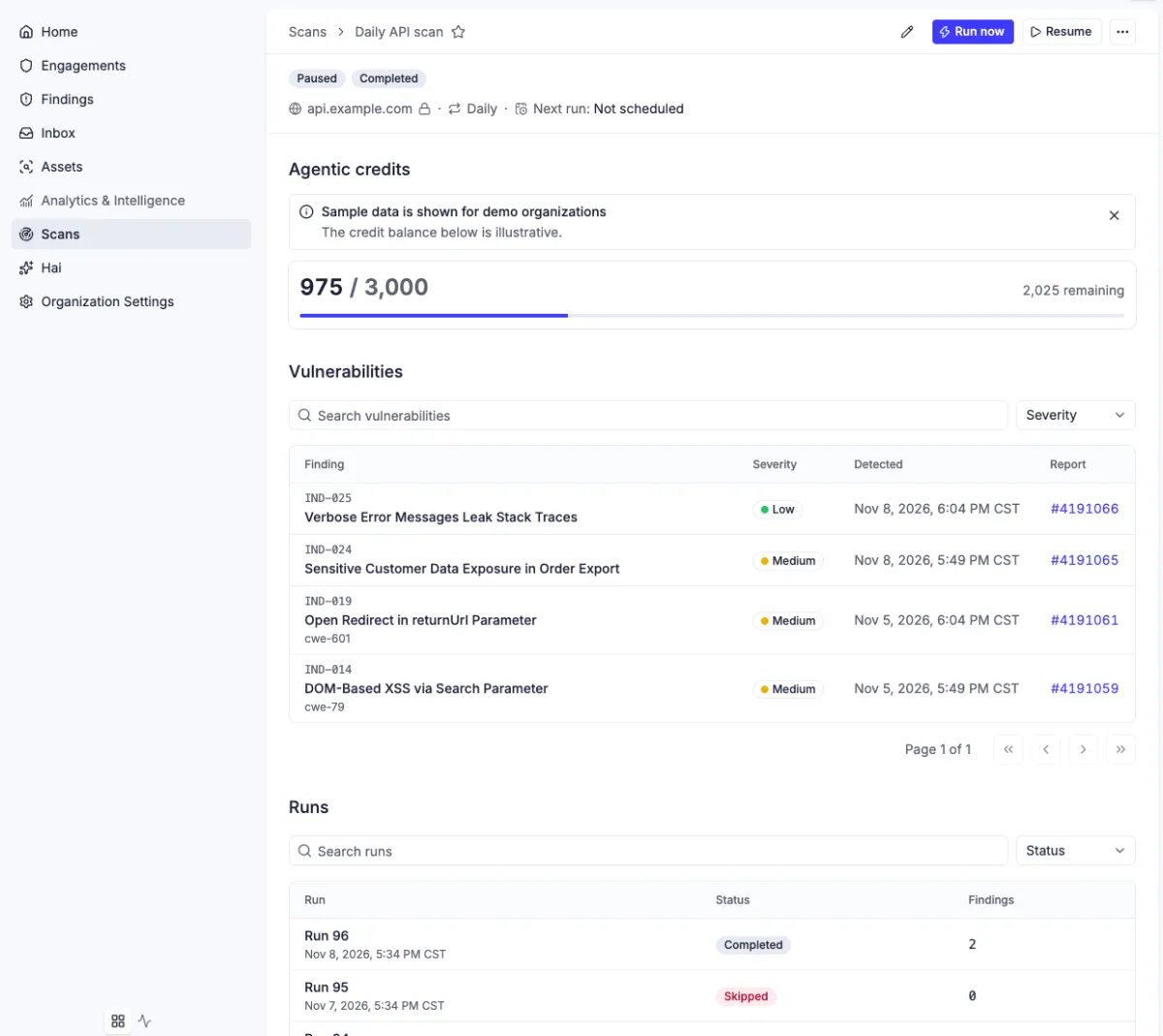
- Scan. Agents generate a prioritized list of potential vulnerabilities, which we call Indicators, ranked by context and likely exploitability rather than vulnerability class or static severity scores. New Indicators appear as your attack surface changes.
- Exploit. Exploit agents take each Indicator and attempt to confirm it’s actually exploitable in your environment. Failed attempts are logged too, so you and your auditors have a record of what was tested.
- Report. Confirmed findings land in the H1 Platform with attack steps, payloads, and impact attached.
That exploit step is what turns a possible issue into a validated one. An Indicator is a lead for an agent to chase, not a ticket for your team. Findings are reported only after an agent has validated them through an exploit attempt, so you start with demonstrated risk instead of a list of possibilities.
It also rechecks its own work. As fixes ship, agents revalidate previously found vulnerabilities to confirm each one is actually resolved, because a closed ticket doesn’t prove the hole is gone.
With optional source code integration, agents gain application context for more targeted testing as your code changes. Code-level fix recommendations and PR-ready guidance can also be enabled, powered by H1 Remediation.
Where to Start
H1 Continuous Testing runs on agentic credits, the single prepaid pool that HackerOne customers on the H1 Platform with credits enabled can use across eligible agentic workflows. Your admins control which workflows draw on credits, so they can turn H1 Continuous Testing on and off as needed. H1 Platform customers on our agentic credit model can enable H1 Continuous Testing directly, while others can reach out to their HackerOne representative to confirm eligibility and get started.
For H1 Bounty customers, H1 Continuous Testing can extend validated, exploitable proof across the web applications and APIs outside your bounty program's critical-asset scope, at a pace closer to how often you actually ship, so your researchers stay focused on the complex, high-value vulnerabilities that automated testing can miss.
For H1 Agentic Pentest customers, it can cover the time between engagements for the web applications and APIs you onboard, continuously testing and validating findings while you wait for the next scheduled assessment.
If you’re newer to HackerOne, H1 Continuous Testing stands on its own with the H1 Platform: continuous, autonomous exploit validation across the web applications and APIs you onboard, with supporting evidence attached to each finding.
Together, H1 Bounty, H1 Agentic Pentest, and H1 Continuous Testing cover the full range, from honest mistakes to critical vulnerabilities, each confirmed with proof before it ever reaches your team. H1 Remediation closes the loop by turning that proof into a shipped fix, delivered directly into the tools your team already uses.
H1 Continuous Testing is available today as a core capability of the H1 Platform, through a flexible pool of agentic credits, so you can start on one application and expand coverage as you see results.