56% Faster Validation: An Agentic Workflow for Continuous Exposure Reduction

AI widens what you have to defend and shortens the time you have to react. If validation and remediation lag behind, the backlog turns into exposure time. That is when breach windows open.
Most teams already have visibility into issues. The gap sits in turning that signal into action: confirm impact, pick the next move, and get fixes shipped.
That “decision layer” sits at the center of Continuous Threat Exposure Management (CTEM). CTEM—an approach to continuously identify exposure across your environment, validate what’s real, prioritize based on context, and drive remediation as an ongoing loop, not a quarterly fire drill. When the loop is tight, leaders get proof of real risk, and teams reduce exposure between audits. When it’s loose, work piles up and risk lingers.
We’re introducing agentic validation powered by Hai, our agentic AI system. Hai runs coordinated checks across scope, eligibility, duplicates, and priority, then gives reviewers a recommended next step with the rationale.
In early use, teams have seen a 56% reduction in time to validate, helping shrink exposure time.
You Can’t Prioritize What You Can’t Prove
As attack surfaces expand, three problems show up in every program:
Eligibility drift
Teams waste cycles reviewing findings that don’t meet scope, policy, or quality standards. The queue grows, reviewers burn time, and real issues wait behind noise.
Duplicate churn
The same underlying vulnerability shows up in different packaging. Slightly different reproduction steps. Different assets pointing to the same root cause. The result is a clogged backlog, more debate, and slower fixes.
Priority without context
Generic scoring can’t reflect how your business actually runs. Asset criticality, exploitability signals, user impact, and operational risk vary widely across environments. Without context, “high severity” becomes a label rather than a decision.
If you lead security programs, you have seen this up close. Base scores alone do not drive action. You need defensible reasoning so the right owners move quickly and you can explain the why.
The Outcomes Leaders Actually Need
A modern CTEM program has to produce outcomes you can measure and defend, including:
- Proof of real, exploitable risk, not just suspected issues
- Continuous validation between audits, so exposure doesn’t drift silently
- Faster remediation, with clearer ownership and fewer triage loops
- Reduced incident risk, because high-impact items don’t sit in limbo
- Clear evidence for executive decisions, including where investment moves the needle
Those outcomes come from making better, faster decisions on the findings you already have.
A Continuous Workflow that Turns Reports into Next Steps
The agentic validation workflow delivers decision-ready recommendations through multi-agent orchestration that unifies:
- Intake and policy checks
- Deduplication with reasoning
- Contextual prioritization
- A single recommended next action for human review
Instead of analysts stitching together context across reports, tickets, and tools, the workflow produces one trusted recommendation that’s ready for a reviewer to approve, route, and act on. Every decision feeds back into the system, refining future recommendations.
Only HackerOne combines AI for breadth, researchers for depth, and a unified platform that drives remediation from report to resolution.
Four Steps that Keep Exposure Moving
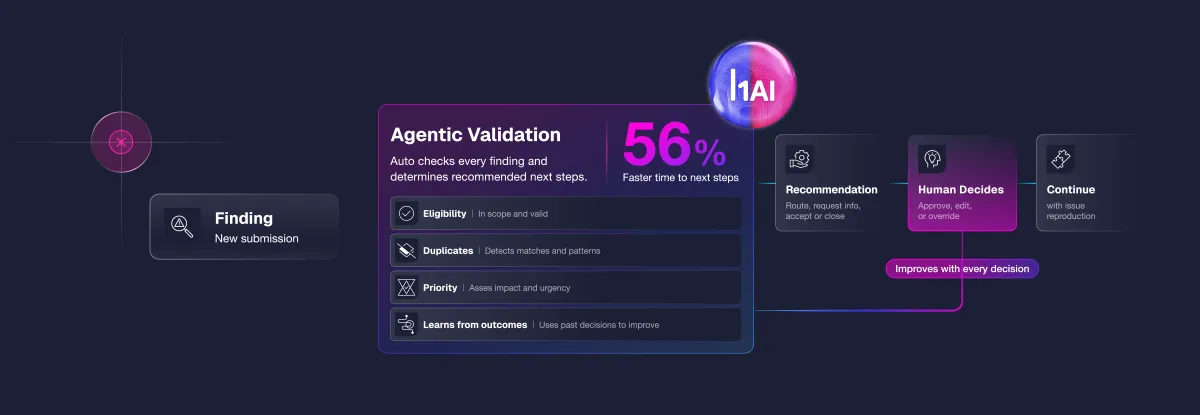
1) Qualify what belongs
Coordinated scope, policy, and eligibility checks happen before findings reach review. That means teams spend time on issues that qualify, not on sorting out what never should have entered the queue.
Outcome: Less noise, faster throughput, fewer stalled reviews.
2) Collapse duplicates with clear reasoning
Similar reports are grouped, with an explanation of why they match. The workflow highlights overlaps, gaps, and implications so reviewers understand what’s truly net-new without having to reinvestigate past decisions.
Outcome: Fewer repeated debates, cleaner queues, faster triage.
3) Prioritize with business context
Urgency is weighed using factors teams actually use: exploitability signals, asset importance, and business impact. Priorities are communicated in a way that analysts, developers, and leaders can act on without translation.
Outcome: Better sequencing, clearer ownership, faster remediation on what matters.
4) Improve continuously from outcomes
Recommendations improve through the same feedback loop teams already rely on: analyst decisions, program policy, and past outcomes. Precedent builds from how your team handles real scenarios, like how your team weighs severity, which closure states match which scenarios, what bounty ranges align with past payouts, so next steps align with how you actually run the program.
This creates compounding value. Accuracy improves as your program runs because the system learns from real decisions and outcomes over time. Institutional knowledge that used to live in analysts’ heads is encoded in the system, reducing ramp-up for new team members and keeping decisions consistent across team changes.
Outcome: Increasing consistency, fewer edge-case misses, and a validation baseline that improves between audits rather than resetting.
A Faster Workflow Only Matters If Teams Trust It
Trust comes from clear boundaries and visibility. That’s why you can inspect every check behind a recommendation. When Hai detects low confidence, it flags uncertainty so analysts know where to focus. Our security and trust documentation details the controls that govern how Hai operates.
Analysts approve, edit, or override every recommendation, and those decisions feed back to improve future accuracy. After 5 months in production, teams accept recommendations 94% of the time. Accuracy improves as volume grows, which you can’t get with a static rules engine.
The goal isn't to replace judgment. It's to give reviewers a well-reasoned starting point so they spend time on decisions, not data gathering.
See how Hai keeps humans in control while turning recommendations into next steps.
About the Authors