Why the Best Researchers Are Thriving in the Age of AI

After the last table had finally cleared, the waiter sat with his phone and did some math. He was less concerned about the night’s takeaway and more preoccupied with escape velocity. How much money did he actually need to live, month-to-month, if he stripped everything back? The figure was smaller than he expected. And then he did the other calculation, the one that changed everything. One bug. One responsibly disclosed vulnerability in one company's software. At even modest bounty rates, that was the whole month covered.
He was nineteen, working a job where he felt invisible when he wasn't being treated badly, and had just figured out that the thing he'd been doing for fun since he was fifteen might be worth betting his life on. He quit the next day.
"I thought I was too late," Hacktus says now. "I really thought the window had closed."
It had not closed. The first year working part-time as an ethical researcher, he earned $8,000, enough to confirm the math. Then $100,000 the next, each year's number arriving like proof of a theorem he'd already accepted on faith.
Four years after that waiter shift, Hacktus is one of 77 researchers in HackerOne's history to have crossed $1 million in bug bounty earnings. He got there via more than 1,500 valid vulnerabilities, report-by-report, year-by-year, on targets ranging from scrappy startups to some of the largest companies on the internet. No single lottery ticket. Just compounding judgment, applied patiently, in conditions that would have exhausted someone less adapted to them.
The Multiplier Effect
The security research industry has been in a low-grade panic about artificial intelligence. Walk into any security conference in the past two years and you'll hear some version of the same fear that AI will automate what ethical security researchers do, find the vulnerabilities before the humans get there, write the reports, collect the bounties, and gradually hollow out a field that took decades to build into something legitimate. The implication, rarely stated but always present, is that researchers like Hacktus are working against a closing window.
Hacktus doesn't buy it.

He uses AI extensively, but with a discipline that most conversations about AI tools tend to skip entirely. He never hands it the wheel; he feeds it leads instead. Something that used to take him three or four hours, an agent completes in about fifteen minutes, and while the agent works, he's already hunting something else. He'll point a model at an unfamiliar codebase and have it map where authentication is actually enforced versus where it's merely assumed, rather than reading through thousands of lines himself.
"The model reads fast and brings no judgment," he says. "I read slower and bring the judgment.”
The guardrails are deliberate and non-negotiable. No delete access. No write access. The AI handles the surface work: discovery, mapping, the early reconnaissance that used to consume his mornings. Hacktus handles exploitation, the part that requires deciding what's actually dangerous and building a proof of concept a security program can't ignore. While one agent runs a thread, he's already opening another. Of the work, he says, “I keep the part that matters."

At live hacking events, where dozens of the world's best researchers descend on the same targets over seventy-two hours, you can feel the shape of the advantage shift in real time. Picture a hotel conference room, laptop screens glowing, researchers moving between targets with the focused quiet of people who know that the same bug found by two people pays only once. The bottleneck in that room was never tooling. It was always instinct: knowing which door to try first. AI makes the experienced researcher faster at the right things. It makes the inexperienced researcher faster at the wrong ones.
The same technology everyone predicted would hollow out this field has instead created more surface area, more complexity, and more opportunity for researchers who know what they're doing. The evidence is in Hacktus's earnings. It's also in what he's hunting, and where.
More Code, More Gaps, More Opportunity
More vulnerable code is being produced than every researcher on earth could find. The gap is growing, not shrinking. Hacktus will tell you this plainly, without hedging, which is the thing that surprises people who expect a researcher of his level to be more bullish on the state of internet security.
"More surface area, more complexity, more code produced by people who've never thought about what an adversary might do with it," he says. "That's the world now."
The mechanism is straightforward and a little frightening. AI has made it possible for people with no security background, no software engineering training, and no coherent threat model to ship production applications used by real people with real data. The code these tools produce isn't uniquely terrible. It's just abundant, and it's written by people who shipped the happy path without ever asking what an adversary might do with the sad one. They didn't know to ask. The model didn't volunteer the question.
Hacktus can identify this code quickly, sometimes within minutes of looking at a target. Over-commented, the telltale sign of a generator that explains every line because it can't assume the reader knows anything. Multiple competing patterns for the same function within a single file, written in chunks without awareness of each other. Error handling that looks complete but misses the edge cases that actually matter. Authentication logic that's present but subtly wrong in ways that only become obvious when you're trying to break it. And lately, a more literal tell: configuration files left publicly reachable in production. CLAUDE.md. Cursor rules. Agent prompt logs.
"Nobody who's thought about what they're shipping leaves those exposed," he says.
When bugs appear in applications built around AI systems, the vulnerability is almost never in the model itself. It lives in the plumbing around it: the trust boundaries, what the agent is allowed to call, how its outputs get handled downstream, whether a carefully constructed prompt can instruct it to act on behalf of someone it shouldn't.
"Prompt injection is only frightening because of what you connected downstream of it," Hacktus says. "On its own it's just text."
He's published research on exactly this pattern. An MCP OAuth account takeover built on a forgotten PKCE assumption. An agent authorization confusion bug where an AI could be manipulated into treating another user's data as its own. In both cases, someone connected a language model to a consequential action and forgot that anything the model outputs is, from an attacker's perspective, fair game.
Where Judgment Still Wins
If there's one class of vulnerability where the human edge holds, it's the one AI is worst at: business logic. It's nothing new, it's one of the oldest categories in the book, but it's exactly the kind of flaw a model walks right past. A friend of his, someone with no security background and no knowledge of bug hunting, recently found a significant vulnerability by doing something no scanner would think to do: sitting with a system long enough to understand what it was built for, then asking what would happen if someone used it in a way nobody intended. The bug wasn't in the code's execution. It was in the assumptions baked into the design. That's what makes business logic different: you don't need to know how to hack to find one. You just need to think sideways.
"The AI tends to test the application the way it was designed to be used," Hacktus says. "It won't step outside those lines unless you explicitly show it the way. It doesn't naturally think: what if I use this flow in a way nobody intended?"
AI is genuinely strong at the mechanical bugs: broken access control, privilege escalation, patterns it can recognize and act on at speed. Those vulnerabilities have shape. Business logic bugs are shapeless by definition, each one a custom problem that requires someone who can hold a mental model of a system, understand the business context around it, and imagine what a motivated adversary might see that the developers missed. Hacktus keeps that work for himself.
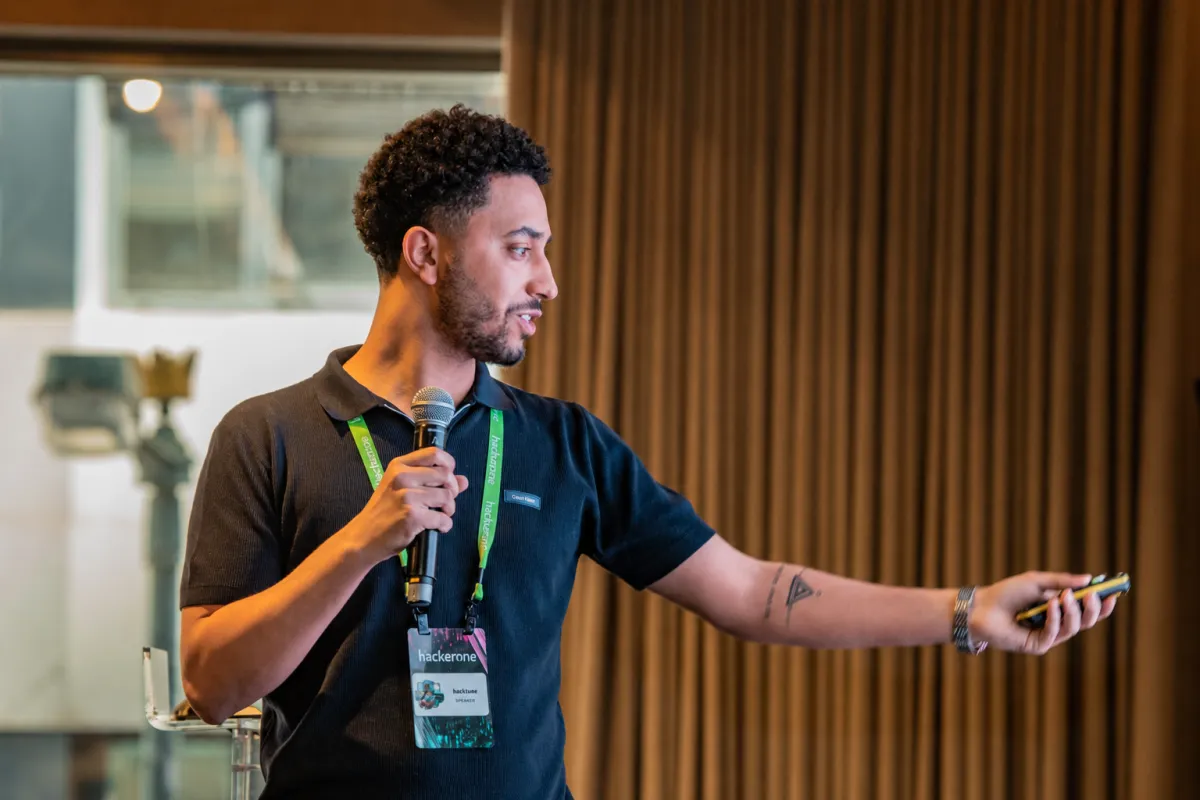
The researchers who will define the next era of this field aren't the ones with the best tooling. They're the ones who understand how industries work, how products get built, what assumptions teams make under deadline pressure, where the gaps between intent and implementation tend to open. That kind of expertise is slow to develop, impossible to generate on demand, and resistant to conditions that wash out everyone who can't wait.
The Researcher Behind the Reports
Hacktus is twenty-four years old. He has a girlfriend who, he acknowledges with the particular gratitude of someone who logs long sessions without noticing the hours, takes care of him and keeps him comfortable while he works. He visited fourteen or fifteen countries in 2025, often working in the quiet days around live research events, laptop open, couch or coffee shop or restaurant, wherever he happened to land. The hours are uneven. Some days he's heads-down for fourteen, fifteen, seventeen hours without noticing the time. Then there's a week where he doesn't open the laptop at all.
His handle came from a fellow hacker, @monke, who was visiting one day, saw how many cacti Hacktus had crowded onto his patio, and said it almost as a joke: hacker, cactus, why not be a Hacktus? The name stuck. One of those cacti he forgot about for the better part of a year, closed up inside doing what he does, and when he finally opened the door and looked, it had grown substantially on its own. No maintenance. No attention. Just a thing that was built to outlast neglect.
He tells newer researchers not to worry about timing.
"Target new fields, new bug classes, lesser-known areas," he says. "Automate your processes. Always do your research. There's so much slop and noise now, people firing off AI-generated reports they don't understand and hoping something sticks."
Some months the math is easy. Some months it's zero, and he runs the three-month rolling average and waits, knowing from experience that it evens out. The field rewards patience the way it rewards judgment: quietly, unevenly, and then all at once.
The gap between vulnerable code being produced and researchers finding it keeps widening. So does his lead.
Ready to find your own path in security research? Explore opportunities with HackerOne.
About the Author